
Last checked 2 October 2026
General information: This article is general information only. It is not financial, legal or tax advice.
Editorial note: This article contains no affiliate links. EatCryptoPie does not recommend any crypto asset, network or crypto platform in this article.
Scope: This guide uses Bitcoin and Ethereum as worked examples because both are public blockchains with detailed public documentation. Other networks can work differently, and the differences can matter.
A blockchain is a way of keeping a shared record of transactions without relying on one organisation to hold the master copy. It is often described as “unchangeable” or “tamper-proof”. The reality is more specific, and more useful to understand: a public blockchain such as Bitcoin or Ethereum makes changes to past records easy to detect and, as time passes, very expensive to carry out.
This guide explains the main parts: the ledger, transactions, blocks, and how a network agrees on what happened, including the two best-known approaches, proof of work and proof of stake. If you are new to crypto, start with What Is Cryptocurrency?
The ledger: a shared record
A ledger is a record of transactions. The Bitcoin developer documentation describes Bitcoin’s blockchain as “an ordered and timestamped record of transactions”. ethereum.org describes a blockchain more generally as a public database that is updated and shared across many computers in a network.
Those computers are called nodes. On Bitcoin, full nodes download and verify every block and transaction before passing them on to other nodes. Because many independent copies are checked against the same rules, no single organisation’s copy is the official one. The US National Institute of Standards and Technology (NIST) describes blockchains as digital ledgers kept in a distributed way, “usually without a central authority”.
Australian government sources often use the broader term distributed ledger technology (DLT). ASIC’s guidance refers to “distributed ledger technology (DLT) or blockchain”, and the ATO says crypto assets use distributed ledger technology to record transactions.
What the ledger keeps track of differs between networks. Bitcoin records transactions that spend amounts received in earlier transactions; the developer documentation calls the amounts not yet spent “unspent transaction outputs”. Ethereum instead keeps track of accounts, each with an ETH balance.
On a public network such as Bitcoin, the record is visible to anyone. bitcoin.org notes that anyone can see the balance and transactions of any Bitcoin address, although the identity behind an address stays unknown until it is revealed some other way, for example during a purchase.
Transactions: authorised instructions
A transaction is an instruction sent to a blockchain network. It might transfer crypto or, on networks such as Ethereum, interact with a smart contract. In the Bitcoin and ordinary Ethereum account examples used here, transactions are authorised using cryptographic signatures tied to private keys. ethereum.org explains that the signature proves the transaction could only have come from the sender. The Bitcoin documentation describes a signature as a value that could only reasonably have been created by someone holding the matching private key. Understanding Private Keys & Seed Phrases explains keys in more detail.
Once authorised, the transaction is broadcast to the network. On Bitcoin, each full node checks it independently before passing it on. Among other things, it checks that the amounts being spent have not already been spent, and that the transaction does not pay out more than it spends. Valid transactions then wait in a holding area, often called the memory pool or mempool, until they are included in a block. Ethereum works in a similar way: a submitted transaction joins a pool of pending transactions until a validator includes it in a block.
These checks are about the network’s rules, not about whether a payment is a good idea. A transaction you correctly authorise and send to a scammer passes every check.
Blocks: batches linked in a chain
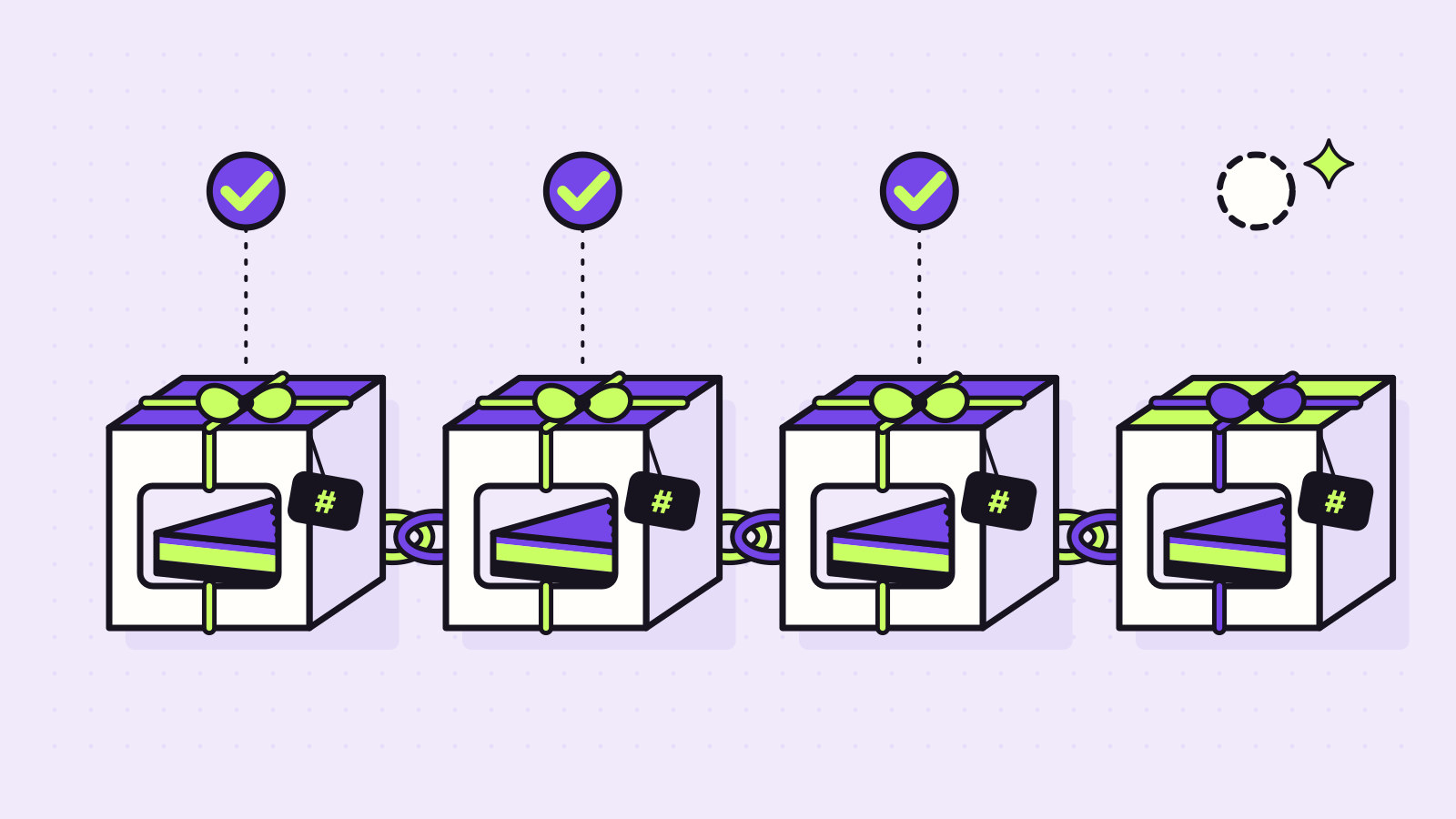
Pending transactions are grouped into blocks. Each block includes a hash of the block before it. A hash works like a digital fingerprint calculated from the block’s data, so any change to the data changes the hash.
That link is what makes it a chain. ethereum.org explains that one change in any block in history would change all the hashes that follow, and everyone running the blockchain would notice. The Bitcoin documentation makes the same point: a transaction cannot be modified without modifying the block that records it and every block after it.
The pace differs between networks. On Bitcoin, new blocks are added about every 10 minutes on average. On Ethereum, time is divided into 12-second slots, with one block proposed per slot, although a slot can sometimes go empty.
Validation and consensus: how the network agrees
Two separate jobs keep a blockchain consistent.
Validation is checking. Nodes check each new block and its transactions against the network’s rules and reject anything that breaks them. On Bitcoin, every full node does this, not only the computers that create blocks.
Consensus is agreeing. ethereum.org defines a consensus mechanism as the protocols, incentives and ideas that allow a network of nodes to agree on the state of a blockchain. ASIC’s guidance describes it as the algorithms nodes run to verify and agree on records posted to the ledger. In practice, a consensus mechanism has to settle two questions: who gets to add the next block, and which version of history to follow if two valid versions appear at the same time.
Proof of work and proof of stake are the two best-known answers to the first question. ethereum.org notes that, on their own, they are not complete consensus protocols; a network also needs a rule for choosing between competing chains.
Proof of work (Bitcoin)
On Bitcoin, the computers that create blocks are called miners. A miner gathers pending transactions into a candidate block, then repeatedly hashes the block’s header, changing a value each time, until the result falls below a target set by the network. There is no known shortcut: the Bitcoin documentation describes a valid result as one that can only be obtained, on average, by doing a certain amount of brute-force work.
The first miner to find a valid result broadcasts the block. Other full nodes check the block against Bitcoin’s rules. Miners working on the next block then build on top of the latest valid block. Checking a claimed result is quick compared with finding one.
A few rules keep the system steady:
- Difficulty adjusts. Every 2,016 blocks, the network resets the target based on whether those blocks took more or less than two weeks to produce. This keeps the average close to one block every 10 minutes.
- Miners are paid in new bitcoin plus fees. The first transaction in each block pays the block reward, made up of newly created bitcoin (the block subsidy) plus the fees from the block’s transactions. Under Bitcoin’s rules, the subsidy halves every 210,000 blocks, roughly every four years.
- The chain with the most work wins. If two valid versions of the chain appear, nodes follow the one that would take the most work to recreate and discard blocks from the other. This is often called the “longest chain” rule, after the wording in Bitcoin’s original 2008 paper.
Proof of work protects history by making it expensive to rewrite. To change an old block, an attacker would have to redo the work for that block and every block after it, then overtake the rest of the network. The original Bitcoin paper calculated that the chance of a slower attacker catching up falls exponentially as more blocks are added. The best-known risk is an attacker who controls more than half of the network’s mining power.
That security comes from real computing work, and the work uses electricity. ethereum.org estimates that Ethereum’s own miners were using about 70 TWh of electricity a year before Ethereum stopped using proof of work.
Proof of stake (Ethereum)
Ethereum used proof of work until The Merge on 15 September 2022, when it switched to proof of stake.
Under proof of stake, blocks are proposed and checked by validators. Instead of competing in a proof-of-work hashing race, validators put ETH at stake as collateral by depositing it into a smart contract. ethereum.org says that to run a validator, a user must deposit 32 ETH and run three separate pieces of software.
For each 12-second slot, one validator is selected at random to propose a block. A randomly chosen committee of other validators checks it and votes on it; these votes are called attestations. Validators who break certain rules, such as proposing more than one block in a single slot or submitting contradictory votes, can have part of their stake destroyed. This is called slashing. ethereum.org says the penalty can be minor for a single validator acting alone, but can reach 100% of a validator’s stake in a mass slashing event.
Ethereum also has a formal point at which history is settled. Every 32 slots (one epoch), there is a checkpoint. When validators representing at least two-thirds of all staked ETH vote for a pair of checkpoints, the earlier one becomes finalised. ethereum.org says this currently takes about 15 minutes. To reverse a finalised block, an attacker would have to lose at least one-third of all staked ETH.
Without the mining race, energy use fell sharply: ethereum.org estimates Ethereum’s energy consumption dropped by about 99.95% after The Merge.
The Merge did not require ETH holders to do anything with their funds or wallets, and ethereum.org warns that people saying otherwise were likely scammers. Treat any message claiming that a network upgrade requires you to move your crypto or reveal your seed phrase with the same suspicion.
| Proof of work (Bitcoin) | Proof of stake (Ethereum) | |
|---|---|---|
| Who adds blocks | Miners | Validators |
| Main economic resource | Hashing work and electricity | Staked ETH, which can be slashed |
| How often blocks are added | About every 10 minutes on average | 12-second slots; some slots have no block |
| When a transaction is settled | Gradually: each new block on top makes reversal harder | When its block is finalised, about 15 minutes later |
| Main attack risk | Controlling more than half of the mining power | Controlling a large share of staked ETH, at the risk of losing it |
When is a transaction final?
A transaction does not become irreversible the moment you send it.
On Bitcoin, bitcoin.org explains that transactions accumulate confirmations, each making them harder to reverse. A transaction’s confirmations count the block that contains it plus every block added after it. For high-value transfers, bitcoin.org recommends waiting for at least six. Until then, a block can occasionally be replaced by a competing one, and its transactions can go back into the waiting pool to be included again.
On Ethereum, a transaction is first included in a block, then becomes final when that block is finalised, about 15 minutes later according to ethereum.org.
After that, reversing it is not a practical option on the network itself. bitcoin.org puts it plainly: a Bitcoin transaction cannot be reversed, only refunded by the person who received it. Moneysmart notes that scammers use crypto partly because transactions are not easy to recover.
That is why NIST’s description is more accurate than “tamper-proof”. Blockchains are tamper-evident and tamper-resistant: changes are easy to detect, and they get harder to make as time passes.
Not every blockchain works like this
Bitcoin and Ethereum are useful examples, but they are not templates for every crypto system.
- Different consensus methods. Proof of work and proof of stake are not the only options. NIST describes several others, including round robin, proof of authority (also called proof of identity) and proof of elapsed time.
- Permissioned blockchains. On a permissionless blockchain such as Bitcoin, anyone can publish blocks without needing permission from an authority. On a permissioned blockchain, NIST explains, people publishing blocks must be authorised by some authority. ASIC’s guidance notes that whether nodes need authorisation depends on how a particular ledger is set up and governed.
- Different records, speeds and settlement. As above, Bitcoin and Ethereum keep their records differently, add blocks at different rates and settle transactions differently.
- Tokens that use another blockchain. Many crypto assets do not have a blockchain of their own. The ERC-20 standard, for example, is a common way to create tokens within smart contracts on Ethereum, so those tokens rely on Ethereum’s network. Coin vs Token: What’s the Difference? explains the distinction.
- Rules change. Ethereum changed its consensus method in 2022. A description of how a network works can go out of date.
NIST also cautions that blockchain technology “is not a silver bullet”. The word “blockchain” in a pitch does not tell you which network is involved, who can add blocks, how transactions are settled, or who controls the project. Those details are worth checking before relying on any claim.
What a public blockchain does
It keeps a shared record that many independent computers check against the same rules. Changes to past blocks are evident, and once a transaction is deeply confirmed or finalised, reversing it is extremely costly.
What it doesn’t protect you from
Paying a scammer: a correctly authorised transaction to the wrong person is still valid. Sending crypto to the wrong address. Someone else getting your private key or seed phrase. A crypto platform holding your crypto failing or being hacked: Moneysmart warns that many crypto-asset providers are not licensed, so you may not be protected if a platform fails or is hacked. And a blockchain says nothing about whether a crypto asset or project is worth anything.
How to Buy Crypto Safely in Australia covers checking a crypto platform before using it, and What Is a Crypto Wallet? covers who holds the keys. Avoiding Crypto Scams and Staying Safe covers scams more broadly.
The bottom line
A blockchain is a shared ledger. Transactions are authorised according to the network’s rules (often with cryptographic signatures tied to private keys), checked by nodes, grouped into blocks and linked by hashes, so changes to the past are easy to detect. A consensus mechanism decides who adds the next block and which history the network follows: Bitcoin uses proof of work, and Ethereum has used proof of stake since 2022.
The protection is real but specific. A blockchain makes its record hard to rewrite. It does not make every transaction a good one, every crypto platform safe, or every network work the same way.
Sources
Last checked 2 October 2026.
Protocol documents and source code
- Satoshi Nakamoto — Bitcoin: A Peer-to-Peer Electronic Cash System (2008)
- Bitcoin Core source code — block subsidy rule (validation.cpp, commit 7988380)
- Bitcoin Core source code — mainnet parameters (chainparams.cpp, commit 7988380)
- ERC-20 — Token Standard (EIP-20)
Network documentation
- Bitcoin developer documentation — Block Chain
- Bitcoin developer documentation — Transactions
- Bitcoin developer documentation — P2P Network
- Bitcoin developer documentation — Glossary
- Bitcoin.org — Some things you need to know
- ethereum.org — Technical intro to Ethereum
- ethereum.org — Ethereum accounts
- ethereum.org — Transactions
- ethereum.org — Blocks
- ethereum.org — Consensus mechanisms
- ethereum.org — Proof-of-stake (PoS)
- ethereum.org — Proof-of-work (PoW)
- ethereum.org — The Merge
- ethereum.org — Single slot finality
- ethereum.org — ERC-20 Token Standard